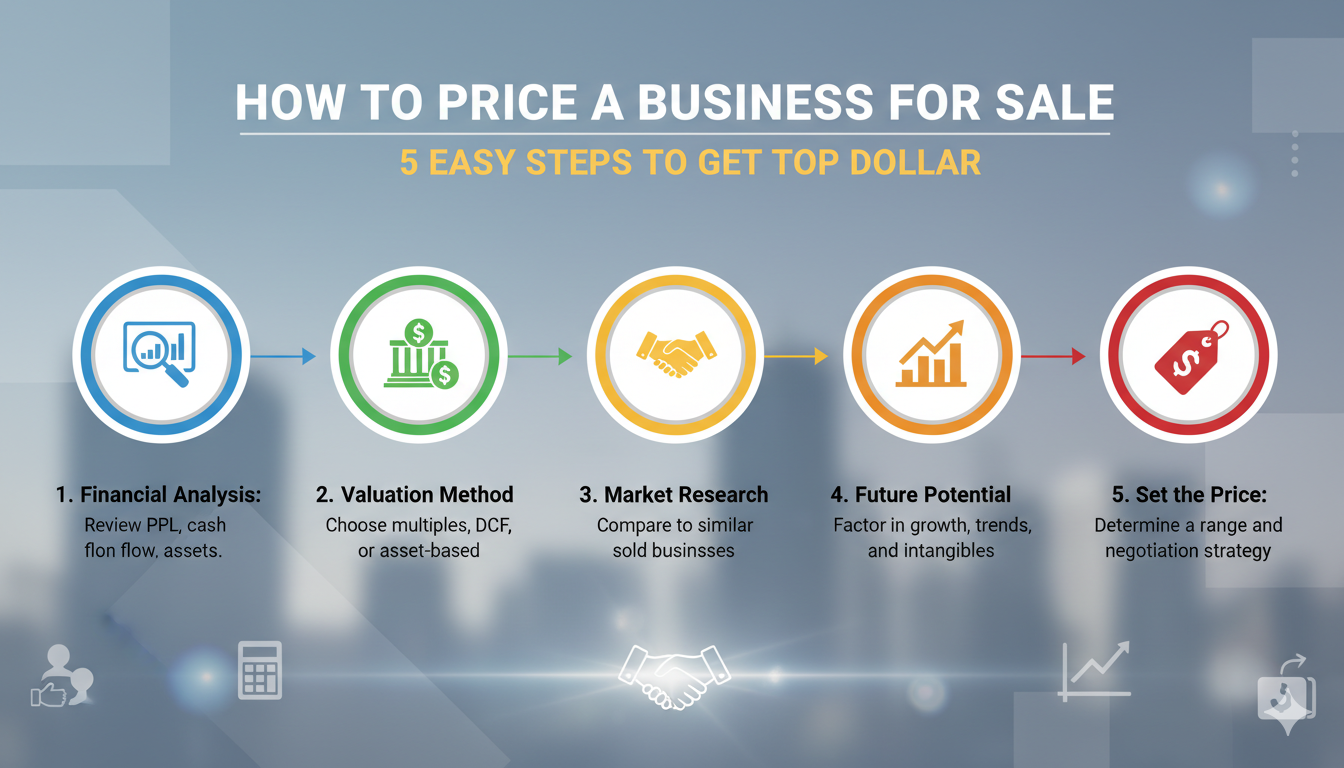
Selling your business is a huge milestone. You have worked hard for years, and now you want to see that effort turn into a great payout. However, many owners struggle with one big question: how to price a business for sale? If you set the price too high, buyers will walk away. If you set it too low, you leave money on the table. It is like trying to find the perfect temperature for your morning coffee. You want it just right so everyone is happy.
In this guide, we will break down the complex world of business valuation into simple steps. We will look at your profits, your equipment, and even your “secret sauce” that makes your brand special. By the time you finish reading, you will feel confident about putting a price tag on your hard work. Let’s dive in and learn how to make your business look like a gold mine to the right buyer.
What Does Your Business Actually Own?
Before you can figure out how to price a business for sale, you need to look at what you physically have. This includes things like your building, your delivery trucks, and the computers on your desks. These are called assets. If you were to close the doors today and sell everything inside, how much cash would you have? This is a great starting point for any valuation.
However, assets aren’t just physical things. They also include your inventory and any money that customers still owe you. When you list these out, you get a clear picture of the “bones” of your company. Many buyers like to see a clean list of assets because it shows them exactly what they are buying. It builds trust and shows that you are an organized owner who cares about the details.
Understanding the Power of Seller’s Discretionary Earnings (SDE)
When learning how to price a business for sale, you will hear the term SDE a lot. This stands for Seller’s Discretionary Earnings. Basically, it is the total amount of money the business makes for one owner. To find this, you take your net profit and add back your salary, your health insurance, and any one-time expenses. It shows a buyer how much money they could personally put in their pocket each year.
Most small businesses are sold based on a multiple of this SDE number. For example, if your SDE is $100,000 and the industry standard is a “3x multiple,” your price might start at $300,000. It is a very fair way to look at value because it focuses on the actual cash flow. Buyers love seeing a steady SDE because it proves the business can support their lifestyle and pay off any loans they took to buy it.
Why Your Industry Changes the Price Tag
Not all businesses are priced the same way. A tech company might sell for a much higher price than a local dry cleaner, even if they make the same profit. This is because some industries grow faster than others. When you are researching how to price a business for sale, you must look at what similar companies in your niche are selling for. This is often called “market-based valuation.”
If your industry is “hot” right now, you might be able to ask for more money. If the industry is struggling, you might have to be more flexible. For example, a software company with recurring monthly subscriptions is very valuable. Buyers love predictable money! Knowing where you fit in the current market helps you set a price that is realistic but also competitive. It prevents you from being the most expensive house on a block where no one is buying.
The Role of “Goodwill” in Your Asking Price
Have you ever wondered why people pay more for a famous brand than a generic one? That extra value is called “goodwill.” When you figure out how to price a business for sale, you have to account for your reputation. Do you have a long list of loyal customers? Is your brand name well-known in your town? Do you have amazing employees who want to stay? These things are worth a lot of money.
Goodwill is harder to measure than a truck or a bank account, but it is very real. A buyer isn’t just buying your tools; they are buying the trust you built with the community. If you have five-star reviews and a massive email list, you can justify a higher price. It is the “magic ingredient” that makes your business stand out from a brand-new startup that has no customers yet.
Using Multiples to Simplify the Math
Many experts say the easiest way for how to price a business for sale is using a “multiple.” This is just a fancy way of multiplying your yearly profit by a specific number. Most small businesses sell for somewhere between 2 and 4 times their annual profit. If you have a very strong business with great systems, you might get a 5x multiple. If the business relies too much on you personally, the multiple might drop.
Think of the multiple as a score for how “healthy” your business is. A high score means the business is easy to run and has a bright future. A lower score might mean there are some risks involved. When you talk to a broker or a buyer, they will almost always ask what multiple you are using. Being able to explain why you chose that number makes you look like a pro who knows their worth.
The Importance of Clean Financial Records
You cannot accurately decide how to price a business for sale if your books are a mess. Imagine trying to buy a car, but the owner can’t tell you how many miles are on it. You would probably walk away! Buyers want to see at least three years of tax returns and profit-and-loss statements. They want to see that your income is going up, not down.
If your records are organized, you can prove your price is fair. If you tell a buyer you make $200,000 a year, you need the paperwork to back it up. Clean books also make the “due diligence” phase much faster. This is the part where the buyer checks everything before signing. If they find mistakes in your math, they will lose trust and might ask for a lower price or cancel the deal entirely.
How to Price a Business for Sale: Summary Table
| Valuation Method | What it Focuses On | Best For… |
| Asset-Based | Physical items (tools, inventory, land) | Stores with lots of equipment |
| SDE Multiple | Total cash for the owner | Small “mom and pop” shops |
| Market-Based | Recent sales of similar shops | Common businesses like cafes |
| Discounted Cash Flow | Future earnings potential | Fast-growing tech or service companies |
| Revenue Multiple | Total sales before expenses | Startups with high growth but low profit |
Considering the “Owner’s Trap”
One thing that lowers the price when learning how to price a business for sale is the “Owner’s Trap.” This happens when the business cannot run without you. If you are the only one who knows the secret recipes or the only one customers want to talk to, a buyer will be scared. They worry that if you leave, the customers will leave too. This makes the business less valuable to them.
To get the best price, you should try to make yourself replaceable. Create manuals for your staff and let your managers handle the daily tasks. A business that runs on autopilot is worth much more than one that requires the owner to work 80 hours a week. When you can show a buyer that they can take a vacation and the business will still make money, your valuation will skyrocket.
Factoring in Real Estate and Location
Does your business come with a building, or do you rent? This is a huge factor in how to price a business for sale. If you own the land, you have two separate things to value: the company and the real estate. Sometimes the land is actually worth more than the business itself! If you rent, the buyer will want to know if the lease is “transferable” and if the landlord is easy to work with.
Location also plays a part. A coffee shop in a busy downtown area is more valuable than one on a quiet backroad. Even if they have the same profit, the downtown location has more “potential.” When you are setting your price, think about how much it would cost a buyer to find a similar spot. A great location is a “moat” that protects your business from competitors, adding value to your final number.
Getting a Professional Valuation
Sometimes, the best way to figure out how to price a business for sale is to ask an expert. You can hire a business appraiser or talk to a business broker. These people look at businesses every day. They have access to secret databases that show what other companies actually sold for, not just what they were listed for. This data is incredibly valuable for setting a realistic goal.
While hiring a pro costs money, it usually pays for itself. An appraiser might find value you didn’t know you had. They also provide a formal report that you can show to banks and serious buyers. It adds a layer of “Expertise and Trustworthiness” to your asking price. When a buyer sees a professional report, they are less likely to try and “lowball” you with a tiny offer.
Preparing for the Negotiation Phase
Once you have decided how to price a business for sale, you have to be ready to talk about it. Buyers will almost always try to negotiate. They might offer you a lower price upfront but pay you the rest later based on how well the business does. This is called an “earn-out.” You need to decide ahead of time what your “walk-away” number is. What is the lowest price you are willing to accept?
Be prepared to explain your math. If you are asking for a 3.5x multiple, tell them why! Maybe it’s because your revenue grew by 20% last year, or because you just signed a huge five-year contract with a new client. Being firm but fair during negotiations shows that you are confident in your business. It turns the sale from a “haggle” into a professional partnership where both sides win.
Conclusion: Taking the Next Step
Figuring out how to price a business for sale is a journey, not a sprint. It takes time to look at your assets, calculate your SDE, and understand your market. But doing this work now ensures that you get the reward you deserve. Remember to keep your emotions out of it; look at the numbers like a buyer would. When you find that perfect price, you’ll attract serious people who are ready to take over your legacy.
You have built something amazing. Now, it is time to put a value on it and start your next chapter. Whether you are retiring or starting a new venture, a well-priced business is your ticket to freedom. Take your time, get your books in order, and don’t be afraid to ask for help from pros. Your future self will thank you for the effort you put in today!
Frequently Asked Questions (FAQs)
1. How long does it take to sell a business once it’s priced?
On average, it takes about 6 to 9 months to sell a small business. If your price is very accurate and your records are clean, it might go faster. If you price it too high, it could sit on the market for years.
2. Should I include my personal car in the business assets?
Only if the car is legally owned by the business and used for work. If it’s your personal ride, it’s usually better to take it out of the deal. Buyers want to see exactly what they need to run the company.
3. What is a “multiple” in business valuation?
A multiple is a number you multiply your profit by to get the total price. For example, a $50,000 profit with a 3x multiple equals a $150,000 price tag. The number changes based on your industry and growth.
4. Can I sell my business if it’s losing money?
Yes, but you will likely focus on an “asset-based” valuation. You would price it based on the value of your equipment, inventory, and location rather than your profits. Some buyers look for “fixer-uppers” they can turn around.
5. Do I have to tell my employees I am selling?
Most owners wait until they have a serious buyer and a signed letter of intent. Telling them too early can cause stress. However, having a loyal team in place makes the business much easier to price higher!